Memory Graph — a living constellation
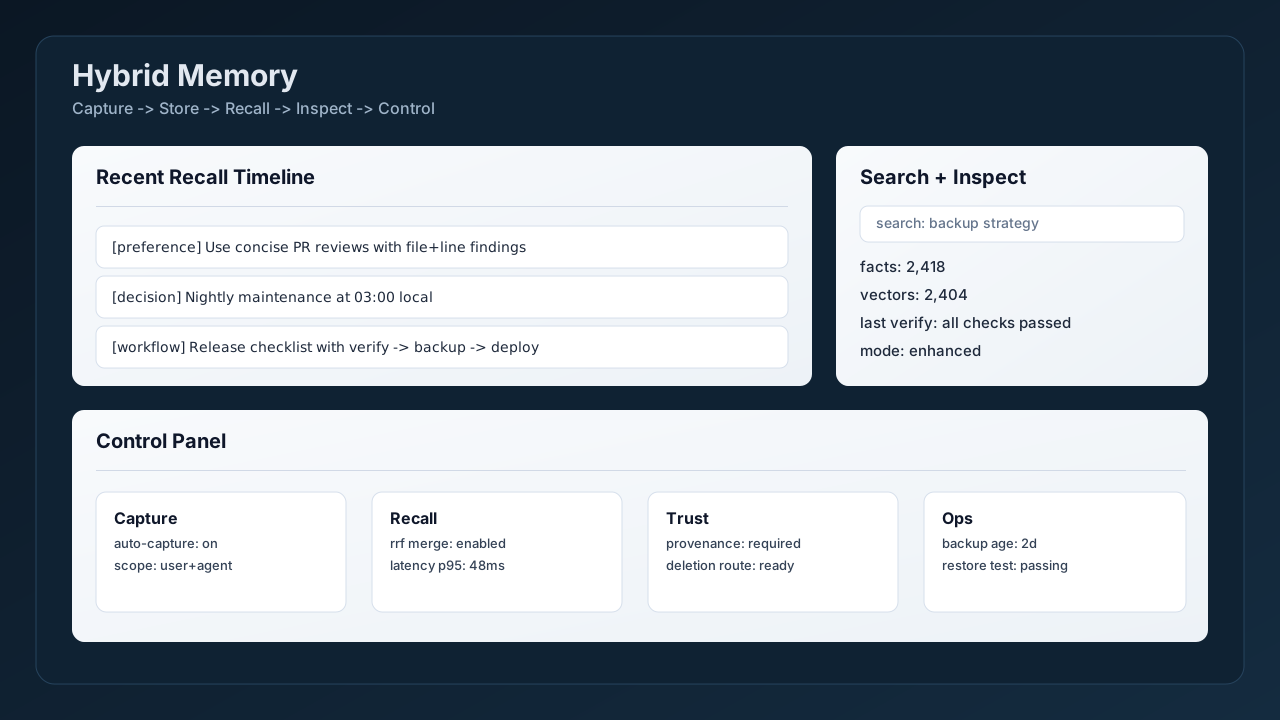
An interactive, real-time visualization of your hybrid memory: every fact is a star, every typed link a bond. The strongest memories gravitate to the center, communities cluster together, and — as your OpenClaw agent works — you watch memories being stored, linked, and recalled live. From the same view you can inspect, edit, add, remove, pin, and re-bond memories, and surface the graph’s gaps and anomalies (orphans, contradictions, weak/suspicious links, stale-but-important facts).
Opening it
The app is served by the plugin’s Mission Control dashboard server (no extra process):
openclaw hybrid-mem dashboard # prints the dashboard URL, e.g. http://127.0.0.1:7700
Then open http://127.0.0.1:7700/graph in a browser. The dashboard server starts automatically with the gateway when dashboard.enabled is true (the default). It binds to 127.0.0.1 only.
If you see a “Memory Graph app not built” placeholder, build the SPA once (it ships pre-built in the published npm package, so this is only needed for local source checkouts):
cd extensions/memory-hybrid/graph-app && npm ci && npm run build
# or, from the plugin root: npm run build:graph-app
What you can do
See the shape of the mind
- Strongest in the center. Each node’s radial position and size come from a composite strength score (importance × recency × confidence, plus pin and recall-frequency boosts — the same
computeNodeStrengththe retrieval engine’s composite score is built from). Central = load-bearing. - Typed, colored bonds.
RELATED_TO,CAUSED_BY,PART_OF,DEPENDS_ON,SUPERSEDES,INSTANCE_OF,CONTRADICTSeach have a distinct color; edge width tracks strength. - Three color lenses. category (memory kind), cluster (client-side Louvain communities with named hulls — labels come from the server’s topic clusters, falling back to each community’s dominant entity/tag), and decay (green fresh → red stale/expiring, from last access, decay class, and any scheduled
expiresAt— spot important memories fading before they’re gone). - Filter & find. Filter the view by category, minimum strength, superseded visibility, and free-text/entity search. The same search box also queries the full store server-side — pick a hit outside the loaded view and the app pulls it (plus its neighbors) in and flies to it.
- Explore outward. Double-click any star (or Expand in the inspector) to pull its immediate neighbors into the view — no full reload, the existing layout stays put.
Watch it think (real-time overlay)
When the agent (or you) operates on memory, the graph updates without a reload:
- New facts appear as new stars; new/strengthened bonds draw in.
- Recalled memories pulse — an expanding ring marks exactly which facts were called upon, with the recall’s per-fact scores.
- A live activity feed streams stores, recalls, and bonds; a green dot shows the live connection. On open, the feed hydrates with recent recall history (from the persisted
recall_eventstable, ownership-gated per caller) so you see what the agent has been recalling lately, not just from-now-on. - Self-healing connection. If the SSE transport drops (gateway restart, laptop sleep), the app reconnects with backoff and re-fetches the base graph to reconcile anything missed — the view never silently drifts from reality, and settled stars keep their positions through the resync.
This works for the whole write surface — the memory_store/memory_link tools, auto-capture, CLI, GraphQL, and maintenance — not just changes made through the app.
Curate
- Inspect any star: full text, provenance, metrics, and its bonds.
- Edit a fact’s text (supersedes the old version and re-embeds), pin/unpin it (keeps it central and decay-frozen), or delete it.
- Add a memory from the toolbar.
- Bond two stars: click Add bond, then click another star. Change a bond’s type or cut it from the inspector.
Mend the gaps
The gaps panel surfaces where the graph needs attention, each item actionable:
- Orphans — unlinked, never-recalled facts → prune or connect.
- Suggested links — embedding-similar but unlinked pairs → accept to bond (needs an embedding provider; on-demand only).
- Conflicts — unresolved contradictions, resolvable in place: keep new / keep old (the loser is superseded by the winner) or both fine (both stand, conflict marked reviewed).
- Weak — low-strength bonds → cut.
- Stale — high-importance facts not accessed in a while.
How it hooks in
FactsDB.store / delete / supersede         services/memory-events.ts       routes/memory-events-bridge.ts
memory_links create / strengthen / update  ───────────────────────────▶    (bridge)  ─────────────▶  graphqlPubSub
memory_recall + auto-recall (with scores)        (in-process event bus)                                    │
                                                                                                            ▼
                                                                             GraphQL subscriptions (Yoga, SSE)
                                                                                                            │
  React SPA  ◀── /graph static assets ── dashboard server (127.0.0.1:7700) ── POST /graphql ───────────────┘
   (react-force-graph-2d canvas, zustand, graphology Louvain, graphql-sse)
- Data plane: the existing GraphQL API (
routes/graphql-*). The app reads the enrichedgraphquery and the gap/insight queries, mutates via the curation mutations, and subscribes over SSE. - Events: backend write paths emit to an in-process bus (
services/memory-events.ts) that a bridge republishes onto the GraphQL pubsub — so tool-path activity (not just GraphQL mutations) reaches subscribers. Recall events carry per-fact scores (recall_events.scores). - Serving: the built SPA is served under
/graphwith path-traversal protection and an SPA fallback (routes/dashboard/graph-app-static.ts).
Configuration & security
The app reuses the existing dashboard config — no new keys:
| Key | Default | Effect |
|---|---|---|
dashboard.enabled | true | Starts the server that also serves /graph. |
dashboard.port | 7700 | Port (falls back to an ephemeral port if taken). |
dashboard.token | — | When set, mutations (create/edit/delete/link/pin) require it. |
- The server binds localhost only; reads are unauthenticated (same-origin, CORS disabled to prevent localhost CSRF). When
dashboard.tokenis set, the app prompts for it (stored inlocalStorage) and sends it as a Bearer header on mutations.GET /api/graph-app/configtells the app whether a token is required. - Scope: every graph read, subscription, and gap query re-derives visibility from the caller’s scope filter — recall pulses only reveal facts you may see, and links require both endpoints in scope.
Development
cd extensions/memory-hybrid/graph-app
npm install
npm run dev        # Vite dev server at http://localhost:5173/graph/
                   #   proxies /graphql (+ SSE) and /api/* to 127.0.0.1:7700
npm test           # pure-logic unit tests (strength, clustering, store deltas)
npm run build      # typecheck + production build → graph-app/dist
Stack: React 18 + TypeScript + Vite, react-force-graph-2d (canvas) with a d3 forceRadial strength layout, graphology + graphology-communities-louvain for clustering (lazy-loaded into its own chunk), zustand for state, and graphql-sse for subscriptions.
Two guards keep the app honest in CI:
- Schema parity — every GraphQL document the app sends lives in
src/api/documents.ts(dependency-free); the plugin testtests/graph-app-schema-parity.test.tsvalidates each one against the live schema, so client/server drift fails CI instead of breaking at runtime. - Browser smoke —
tests/graph-app-e2e.smoke.test.ts(gated byRUN_GRAPH_E2E=1) boots the real dashboard server with a seeded FactsDB, loads the built SPA in headless Chromium, and asserts the constellation renders, recall history hydrates, and a server-side write arrives over live SSE. Locally:RUN_GRAPH_E2E=1 GRAPH_E2E_CHROMIUM=<chrome path> npm test -- tests/graph-app-e2e.smoke.test.ts.
Related docs
- LIVING-MEMORY.md — decay, strengthening, and association dynamics the app makes visible
- GRAPH-MEMORY.md — the typed-link graph model the app visualizes
- ARCHITECTURE.md — the four-part memory architecture
- CONFIGURATION.md —
dashboard.*settings - PUBLIC-API-SURFACE.md — the REST/GraphQL surface
- CONFLICTING-MEMORIES.md — contradictions the gaps panel surfaces